

Recipe for Magic
Three Rules of Portal Fantasy and the Every-person Hero that Drives Them

Among the most enduring tropes of fantasy literature is the idea that an ordinary person can be a hero. It’s so common that it’s difficult to imagine a realm of enchantment without it.
Bilbo Baggins is the ultimate archetype for this theme. He’s a soft, fussy hobbit who doesn’t know the first thing about danger or adventure. He’s practically dragged out of Bag-End to be the dwarves’ burglar despite having no experience.
Yet he outwits Gollum to get the ring of invisibility. He frees his companions from being eaten by giant spiders. He spots Smaug’s weakness, enabling Bard to kill the dragon.
The tiny, unqualified hobbit becomes a hero, and he self-actualizes along the way.
We see this same dynamic at play with the Chosen One trope. Buffy Summers is an ordinary, high-school girl. But only she can prevent demonic apocalypses. Luke Skywalker is a bored farm boy. But only he can face Darth Vader and defeat the Emperor.
The Chosen One is rarely prepared for their role in whatever cosmic drama is unfolding. Yet they self-actualize and become the hero everyone needs in The Moment of Truth.
The appeal of this trope is easy to understand. If anyone can become the hero, then the reader can, too. And given the attraction of fantasy literature as an escape from a dull, abusive, or stressful world into one where goodness matters and evil can be conquered, a narrative supporting the every-person protagonist is especially potent.
No subgenre captures this desire better than the portal fantasy. A person from our world crosses into an enchanted realm and is expected to fight whatever diabolical force threatens to destroy everything. This individual is thrust from a world where they don’t matter at all into one where everyone counts on them.
That creates a powerful sense of actualization for a reader. And the conceit of the main character coming from Earth makes the insertion of reader mind into the magical land all the more immersive.
I’ve loved portal fantasy for decades. They were my favorite type of novel to read in middle and high school. I’ve finally written one myself, and it’s sort of surprising that it took me so long into my career as an author to do it.
So as I get ready to launch my own trilogy next month on Kickstarter, I thought I’d share three key elements of a portal fantasy protagonist necessary to maximize the opportunities in the genre.
The Unbeliever
This is the most basic aspect of a portal fantasy lead character. They come from Earth where there is no magic. They lead a boring or inconsequential life. However they make it to the magical realm, they struggle to believe this is real.
Stephen R. Donaldson practically defined this trope with his Thomas Covenant series.1 His main character suffers from leprosy. He’s been assured there is no cure for it and any hope for that to change is pure delusion. He guards his sense of reality aggressively, fearing it could lead to an accident or greater harm.
So when he arrives in The Land, he is convinced he is hallucinating. Though he allows himself to be led through the adventure by the people convinced he is the Chosen One, he refuses to believe any of it is really happening.
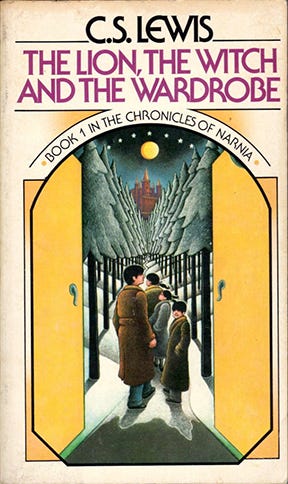
In C.S. Lewis’s classic, The Chronicles of Narnia, only Lucy believes in Narnia and in getting there through the wardrobe, at first. Peter and Susan are convinced she is making everything up. And Edmund, despite having been there himself, encourages this interpretation.
Once everyone is there and finds it real, Edmund resists buying into it being wonderful, because he has been seduced by the White Witch’s lies. He will not accept that Aslan is good, and his jealousy of Peter prevents his believing the prophecies that the four of them are here to end the evil woman’s reign.
For my new series, A Song of Elysée, the main character is a 55-year-old transwoman. Her entire family has betrayed her in one sense or another due to her being trans, and her mother has instilled such a sense of self-loathing in her, that she struggles to believe anyone could want her. She sees herself as an ongoing failure simply for whom she is.
So, when she learns she has been summoned to a fairytale realm to break a curse because she is believed to be a powerful enchantress, she refuses to accept that. She doesn’t believe magic is real, let alone that someone like her could have it. The quest that dominates the series occurs largely because she believes they will have to save the princess some other way.
Seeing the World Anew
Because the protagonist is a stranger to this world (in my series, she is labeled an “Outworlder”), they are the perfect vehicle to bring the magic to the reader.
Lucy is our principal POV character for this purpose in The Lion, the Witch, and the Wardrobe. Her tea with Tumnus gives us the background of what is happening in Narnia, along with the fear most creatures have for the White Witch and her sinister secret police.
But Edmund also gives us a view into the world. Found by the witch herself and tempted with Turkish Delight, he allows us to see Alsan’s foe as the scheming villain she is, especially when she turns on him in the later chapters.
In the first Covenant trilogy, our unwilling hero has lost two fingers to leprosy, causing some of stewards of The Land to see him as a reincarnation of the legendary figure, Berek Halfhand. We learn of Berek’s folly and how it has put everyone in danger in the present. The Lords do not have access to the same magic their predecessors did, so when Lord Foul announces his intention to destroy everything, no one knows how he may be defeated.
Likewise, my MC, Melody Robertson, is brought to Elysée, because she has been identified as the person who can break the curse plaguing the princess of the realm. It’s not until she learns the young woman is aging at five times the normal rate and will die on her next birthday, that Melody realizes she has no idea how to save her.
When she agrees to join a quest to consult first a sphinx and then a mysterious immortal known as The Weaver of Fate to find a solution, she discovers the history of the land and how the princess came to be cursed (as well as all the failed attempts to solve the problem prior to her arrival in Elysée).
In each case, our Outworlder character is the lens through which we see the magical realm and learn of the history impacting its current events.
The Development of Hidden Magic
No matter what the main character believes about themselves, they always have a kind of hidden magic they must develop along the way to resolve the series conflict. It is almost always the reason they were brought to the realm in the first place.
Thomas Covenant still wears his wedding ring, despite being divorced. The ring is made of white gold, which is a metal that does not exist in The Land. Consequently, it has wild magic he has no idea how to summon and virtually no ability to control.
Edmund’s magic is subtler. The prophecy cannot be fulfilled and the White Witch defeated, unless two Sons of Adam and two Daughters of Eve sit on the thrones of Narnia. So the witch demands his blood as a traitor. If he dies, the good guys are one short, and she continues to rule forever. To ensure Edmund will survive to fulfill his destiny, Aslan purchases his life with his own.
(I’ve always been fascinated by the fact that, in writing his Easter allegory, Lewis chooses to redeem rather than condemn his Judas character.)
Melody’s magic first appears in dramatic fashion. With she and her companions surrounded by bloodthirsty goblins and moments from certain death, her desperation triggers a burst of power that turns the goblins into frogs.
Like Covenant, she has no idea how she summoned the sorcery nor how to replicate it. But like Aslan’s sacrifice for Edmund, her magic is transformative. She can make one thing become another, and she spends the rest of the series trying to understand her ability, so that she can break the curse.
Taken together, these three traits are defining characteristics of the portal fantasy subgenre. By having a person from Earth with hidden magic, disbelief, and acting as our window into the world, readers are brought fully from their chair into the mystical land begging to be saved. And they are able to see themselves as being capable of serving as that desperately needed hero.
In a real world currently beset with darkness, that’s a role we all need to envision for ourselves.
Phoebe Ravencraft is an author of queer fantasy fiction and a recovering English major. She adores digging into themes and tropes in her favorite books. Her trans fairytale trilogy, A Song of Elysée, launches next month on Kickstarter. You can follow the project here.
Lord Foul’s Bane, Book 1 in the series, features a consequential rape and has not aged well at all. (One could argue the scene should have been a deal-breaker for his publisher, even if it was the late 1970’s.) Donaldson’s most-successful series is useful for analyzing the portal fantasy subgenre, but I do not support reading it.